
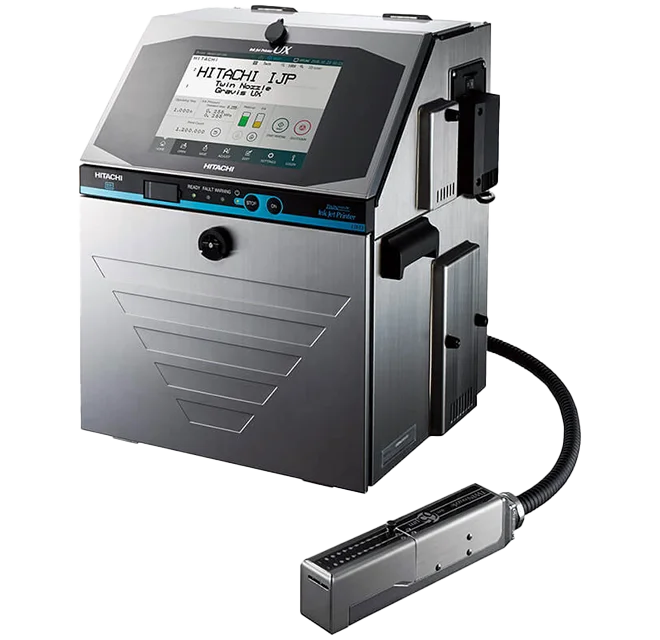
Selecting the right date coding and batch marking printer is one of the highest-impact capital choices for packaging engineers across Nepal's dairy, bottled water, distillery, pharmaceutical, and snack industries. Choosing an under-powered or mismatched coding head results in smeared MRP dates, rejected retail shipments under DFTQC/DDA rules, wasted ink drums, and expensive shift stoppages.
1. Architectural Physics: How CIJ and TIJ Fire Ink Differently
Although both Continuous Inkjet (CIJ) and Thermal Inkjet (TIJ) are non-contact digital batch coders capable of stamping real-time dates, auto-counters, shift codes, and barcodes, their fluid mechanics are fundamentally opposite:
- Continuous Inkjet (CIJ — e.g., Hitachi UX-B160W / UX-D160W): An internal stainless-steel gear pump pressurizes ink cleanly through a 65 μm jewel orifice while a piezoelectric crystal breaks the fluid column into tens of thousands of micro-droplets per second. Unused droplets are sucked back into the gutter and recirculated. Because droplets are electrostatically steered mid-air, the printhead can sit 6 mm to 15 mm away from curved bottle necks, ribbed cables, extruded HDPE pipes, or concave aluminum soda cans at speeds up to 1,148 characters per second.
- Thermal Inkjet (TIJ — e.g., Dotjet DJ45plus, DJ1 & Dailyjet HP1000/HP1200): Utilizes self-contained HP TIJ 2.5 42 ml cartridges where a miniature silicon array of micro-resistors boils ink into firing bubbles on demand. There are no high-pressure pumps, no viscometers, and zero daily purge routines. When a cartridge empties, snapping in a new unit provides a brand-new factory printhead every time, delivering crisp 300 × 300 DPI inline (Dotjet) or up to 600 DPI portable contrast at 2–5 mm printhead standoff.
2. Side-by-Side Technical & Financial Comparison in Nepal
| Decision Parameter | Hitachi UX Series (CIJ) | Dotjet DJ1 / DJ45plus (Inline TIJ) | Dailyjet HP1000 / HP1200 (Handheld TIJ) |
|---|---|---|---|
| Max Throw Distance | 6 mm – 15 mm (recessed cans & uneven surfaces) | 2 mm – 5 mm (requires flush conveyor guide rail) | Roller-guided direct surface contact |
| Line Speed Limit | Up to 1,148 chars/sec (UX-B160W) | Up to 60–75 m/min inline | Manual pass (~30 m/min) |
| Consumable Model | Hitachi JP-K67 Ink + TH-71 MEK Makeup bottle | 42 ml HP 2.5 Solvent or Aqueous cartridge | 42 ml HP 2.5 Solvent or Aqueous cartridge |
| Routine Maintenance | Scheduled nozzle/filter PM (simplified by Hitachi fluid-reduction system) | Zero pump/filter maintenance (wipe nozzle with IPA if left uncapped) | Zero pump maintenance (clip cartridge cap after shift) |
| Cost per Million Prints | Lowest at 50,000+ units/day continuous runs | Predictable cartridge cost; ideal 1,000–25,000 units/day | Best cap-ex for SME batches (<2,500 units/day) |
| Ideal Nepal Sector | Breweries, mineral water bottling, distilleries, PVC/HDPE pipe extrusion | Noodles, spices FFS pouches, pharma cartons on auto-feeders | Master cartons, timber, pipe yards, warehouse drums |
3. Preventing Hidden Downtime & Consumable Mistakes in Nepal
In Nepal's industrial corridors—Birgunj, Bhairahawa, Hetauda, Pokhara, and Biratnagar—three practical realities determine your long-term ROI far more than machine sticker price:
- Evaporative Makeup Losses in Humid vs Dry Seasons: Standard legacy CIJ printers continuously evaporate MEK makeup even on standby. Hitachi UX-Series fluid-reduction design cuts makeup losses by up to 50%, slashing recurring monthly chemical spend. Learn daily operator best practices in our CIJ Maintenance & Viscosimeter SOP Guide.
- Uncapped Cartridge Drying on TIJ Lines: An HP 2.5 solvent cartridge left exposed on an idle conveyor for 4 hours can dry along the thermal orifice plate. Operators need only clip the protective retainer cap between shifts or swap quickly using pure Isopropyl Alcohol (IPA) lint-free wipes.
- Substrate Roughness & Moisture: Condensation on chilled PET mineral water bottles immediately blurs water-based TIJ inks unless an air-knife blower dries the neck—whereas specialized MEK CIJ ink bites cleanly across damp polypropylene and HDPE. For sector-specific workflows, explore our Food & Beverage Bottling Guide and Pharma Packaging Compliance Hub.
4. Recommended Decision Matrix for Your Factory Floor
Quick Selection Rule by Throughput & Substrate
- Bottling, Distilleries, Extruded Cable/Pipe, Wet Surfaces (>20,000 units/day): Choose Hitachi UX-Series CIJ for IP55 washdown safety and curved-neck non-contact throw distance.
- Spices, Snacks FFS Pouches & Pharma Auto-Feeders (1,500–25,000 units/day): Choose Dotjet DJ1 (compact 652 g head) or Dotjet DJ45plus (dual-head + MySQL database linking).
- Master Cartons, Heavy Drums & Flexible SME Lots (<2,500 units/day): Choose cordless Dailyjet HP1000 or touchscreen Dailyjet HP1200.
5. Frequently Asked Questions
What is the primary difference between CIJ and TIJ printing technology?
CIJ circulates pressurized liquid ink through a piezo nozzle with makeup solvent for curved, high-speed, 6–15 mm non-contact throw printing; TIJ uses plug-and-play disposable 42 ml HP 2.5 cartridges with zero pump maintenance for flat cartons, pouches, and semi-flat lines.
Which printer has lower running costs in Nepal?
For low-to-medium runs with frequent start/stop shifts, TIJ eliminates daily standby makeup solvent evaporation and preventive filter kits. For 24/7 continuous beverage bottling (>30,000–50,000+ bottles/day), Hitachi CIJ delivers lower per-character ink cost.
Does Invento stock genuine CIJ fluids and TIJ cartridges locally in Kathmandu?
Yes. Visit our Industrial Coding Inks & Consumables directory or compare models at the Industrial Coding & Marking Nepal Hub.
Request a Free Print Sample on Your Packaging Material
Send your sample cartons, pouches, or bottles to Invento Engineering's Kathmandu demonstration lab for free test coding.